(photo courtesy of Kevin Smith)
Class: II to V; Ave. Gradient: 30 m/km; Portages: probably; Length: up to 6 km, plus the run-out (+10 km); Time: up to 5 hours
Season: year-round; rafts? yes, parts; Highlights: having an audience for your travertine falls hucking; Crux move: the big 5
Water Quality: good; Water Temperature: medium
PI: Agua Azul park (elev: 210m), or above park (elev: 285m); TO: river-right trail, or downstream at Agua Clara
Description: (click here for general notes about my descriptions)
The Agua Azul falls are a classic stop on any Chiapas whitewater itinerary, or any tourist itinerary for that matter. The unending series of travertine falls are stunningly beautiful, especially when the water clears to a turqoise color, and provide a lot of plunking fun for boaters. The shallow lips of the grippy travertine falls and slow-moving pools means it is usually easy to scout your line, either in or out of your boat. Most of the falls are slides, or gently-sloping rapids, but there some good vertical drops to try also. The falls are a lot of fun but not to be taken lightly--not all the slides are smooth, and not all the pools are deep.
Most of the drops are in the first half, and scattered among many different jungly channels, so there are many starting points and routes to choose from, class V near the top, class III-IV after that. Mid-way there is a lull in the action as the river goes mostly flat. Lower down you have the bigger drops of the "Big 5". Up above, there is a tamer section. For more details read on.
When you first drive in to the parking lot, you arrive at the right channel, which is the main channel. Probably the most popular boating option is to put-on in this area where most of the drops are in the class III-IV range. Downstream you just follow your nose through the long series of falls and braids; for me my nose tends to stay left from here down. Watch out for logs and the occasional collapsed ledge. After 30 to 45 minutes you reach the end of this section to arrive at the flat middle part. Some might opt to simply hike back from here, there is a trail river-right to take you back to the park. This first section even gets rafted, though since the rafts generally get stuck on the lip of the falls, "rafting" usually involves vacating the boat, pushing it over the edge, and jumping after it into the pool below.
Those looking for more consequential vertical may want to start up higher, though finding something runnable is not assured. The top of the main channel starts at the top of the tourist walkway where there is a popular swimming area ("Area de Baño #2", also reachable by car). On the walk up you can scout some of the bigger drops, mostly filled with dome falls falling on more dome falls. Perhaps the more interesting route is not on this main-right channel but on the main-left channel. The split happens at the swimming area. If you stay left and you might find a slide-falls sequence followed by couple of stacked good-sized waterfalls, 20-feet and 30-feet tall (viewable from the tourist trail). The main channel regroups above the last tall drop of the top, which is as often jump-portaged as not.
The far left channel is even more extreme and contains some solid V and VI. To get to the beginning of it, keep walking or driving to the end of the river road, then hike up 5 minutes further until you see the split. The first 500 m are relatively easy until you come to a dramatic and violent 200 m-long dirty slide. It can be portaged right, or probably left also. At the bottom stay left to find more big waterfalls, many consequential. If you stay with this left channel eventually you will meet the main channel in the flat part (or there are some other "interesting" routes back to the main channel on the way). A shortcut into the far left channel is to start at the upper swimming area--from there stay left until you get to the larger drops leading back right, where you should get out river-left, walk down the trail 5 minutes, and get to a point at the end of the big slide.
So, however you get there, eventually you end up in the flat part, broken up sporadically by straightforward slides. Here tension mounts as you approach the final "big 5", each requiring a scout and putting most anyone's macho-ness to the test. A short series of slides guides you to the right side of #1, which is broken up into two 30-foot slides (note: on the left it is one tall and intimidating drop). #2 likewise is presaged by some slidy stuff; if #1 gave you more than you wanted, get out early river-right and start portaging to the bottom, otherwise go scout river-left which is where the cleaner lines start. #3 to #5 are the most-portaged drops, partly because shore access is a bit awkward, and mostly because the last two are 50-footers. Good luck.
The last falls drop directly into the Shumuljá river. Having made it this far, you might as well follow it 10 km to the Agua Clara TO. (The Shumuljá has one III-IV sequence early on--rafters say "class V"--followed by another III with the rest being mostly flat with some class II. Note there is an alternate TO at La Esperanza, 2 km below the III-IV sequence, where there is a ruined hammock bridge. This allows a shorter, even hikable, shuttle, though at the time of writing the road down to La Esperanza was not passable by vehicles.)
(Hint: for a video preview of the falls, look for it on YouTube.).
Ignored by most, above the falls there is a short 1.5 km section of smaller, mostly II+, drops. This can be used as a warm-up to the Falls themselves, or just for a bit of fun for those intimidated by the heights down below. Depending on flow, some drops might be considered III- so beginners should choose their lines carefully. The TO is at the top of the second hill street described above. The PI is a 20-minute walk up along the shore past the end of this road. Eventually you come to the "Limite" sign, about 800m above the left-right split, and the rapids at the exit of the springs canyon (impassable). (Those looking to avoid class V should make sure to stay near the right bank on the main/right channel and avoid the entrance to the "far left channel" about halfway through the run.)
*note* This run is marked politically sensitive due to recurring political conflicts between the Agua Azul community and its Zapatista neighbors. Generally though there are no access issues for tourists or kayakers.
Flash Flood Danger: low; in the unlikely event of a mid-day flood, you should have plenty of reaction time.
Descent History: Explorations were done by Cully Erdman and friends starting in 1981. They ran all the lower falls the first time in 1989 for a German film, then again in 1990 for an ESPN/National Geographic film (see the articles page for a link to the clip). Most recently, in 2011 the Adidas Sickline Team (specifically Sam and Matze) claimed a 1st descent on the "first" "60"-footer, which I gather to be the left side of #1.
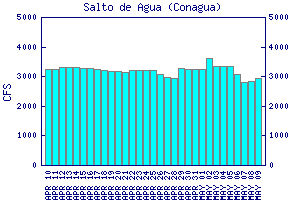
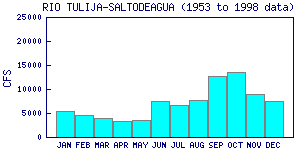
Flow Notes: There is a streamflow gage downstream on the Río Tulijá, linked to below. Only a fraction of the flow here is from the Agua Azul, though. From my handful of visits, my opinion is that the higher the flow, the better for sliding, but a planing-hull kayak with thick plastic will provide fun any time of the year. Expect low, scrapy flows January to May. Below I also show historical flows at the Tulijá gage.
click here for the height graph |
![]() |
Shuttle Notes: Agua Azul is a signed turn off at km 86.3 on the Palenque-to-Ocosingo highway, about an hour from Palenque. As mentioned above, to get to the higher PI's, you can either hike up the tourist walkway or drive to the top on the village's second hill street, which climbs up to near the upper swimming area and continues 300 m further along the river. Walking up further gets you to the top of the left channel and to the class II+ section.
To get to the Agua Clara TO, get back on the highway and go back to km 76.1, where you will find a left turn (signed) onto the 1.5 km-long road into Agua Clara (note that the communities may charge a negociable toll on this road). When you arrive at the Balneario El Salvador, park outside the gate and walk down the public access path to the boat ferry (alternatively, drive into the park and wait there, there is a small entrance fee charged each person though).
The alternate TO at La Esperanza is on the road starting at the payment booth at the entrance to Agua Azul, though the road was not passable for vehicles in 2011.
Accommodations: There are decent cabañas, and a guest house, right in Agua Azul. Otherwise Palenque, 1 hour away, is the area's main tourist center, with many hotels and campgrounds.
Nearby Tourist Attractions: This area has many natural and cultural tourist attractions, these very falls being one of the primary ones. There is also the nearby Misol-Há waterfall and the impressive Mayan ruins at Palenque.