Class: IV upper (V+ lower); Ave. Gradient: 12 m/km (20 lower); Portages: 1+ (10+ lower); Length: 10 km (up to 24 km lower); Time: 3 hours (up to 16 hours lower)
Season: mid-June to December (mid-June to Februrary lower); rafts? no (except bottom bit); Highlights: creeky upper canyon; Crux Move: remembering your safety gear
Water Quality: good; Water Temperature: cold
PI/TO: Naranjal bridge (1160m) to highway bridge (lower: Bambú, 690m, to San Juan or Río Jataté)
Description: (click here for general notes about my descriptions)
The Tzaconejá offers a long stretch of whitewater by draining a good part of the eastern side of the beautiful Chiapas highlands. It's partner in this crime is the Río Jataté, and by the time the two meet at La Sultana they are both good-sized emerald-green rivers, but the Tzaconejá edges it out in both volume and gradient. In fact, as far as kayaking is concerned the Tzaconejá gets a little carried away, with much of the middle section being unrunnable by sane kayakers. It has its moments, though, wonderful ones, especially in the upper section and then the closer you get to the Jataté.
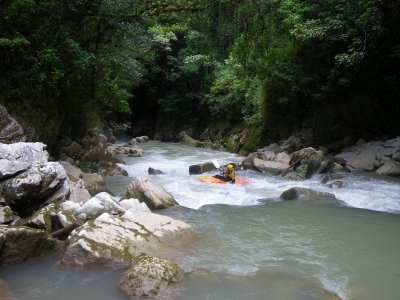
The upper section is a creeking delight, though it's often too low. It runs 10 km from the community of Naranjal to the Altamirano bridge and the bouldery limestone will take class IV paddlers to their limit and then some. The first hour is filled with fun III+ to IV- rapids, then the 1st scout of a steep and boulder-choked rapid signals the start of a section with a deeper canyon and steeper rapids, where you might portage a couple times. The trickiest rapid we found 45 minutes into this section in the middle of a narrow cliffed-in gorge (but with portage options at the rapid). Soon after that drop the rapids start easing up but good stuff continues until the end.
The easiest place to take out is at the picnic area on river left just below the bridge. This "balneario" is managed by the local (Zapatista) community, and the staff was friendly to us on our visit. Note that just across the river from the balneario is where the even-larger Yalchiptic creek flows in.
A 10 km flat section of river follows this point, down to the "Pimienta" bridge.
In the middle section the river abruptly changes character. The next 7 km are the steepest of the entire river as it drops 360m through a rugged canyon, with some segments dropping at a rate of 500 feet/mile. I have not ventured in here, but the first and only descent group reportedly had little enjoyment from the experience (at "low" water); I don't have beta describing how technical the portaging got. After the canyon and for 33 km until the next access at Bambú, the river again goes flat.
Just above the start of the lower section at the Bambú hammock bridge, the Río Independencia comes in. On the last part of the drive in (and in Google Earth) you will see its flood-ravaged delta. With the river now at its full volume, the gradient tilts to over 20m/km for the next 18 km, making for challenging pool-drop rapids. In fact it is one of the longest sequences of class V/V+ in mayanwhitewater-land, and given the volume, the most full-on. Average kayakers like me will spend a lot of time portaging around the generally unclean drops and nasty holes, mostly along the rocky bank but sometimes having to bushwack through the trees. A few of the portages are a bit sketchy but no rope work was necessary at 2000 cfs.
I thought 2000 cfs a medium level; the first descent group did it at "low" water but apparently did not paddle too much on this section either. The scenery and river features are beautiful though. Most of the time you are in a sublime canyon with high limestone cliffs. At times the canyon gets cliffed-in and narrow. In the last part of the canyon the run-to-portage ratio improves and you start to actually enjoy your gorgeous remote surroundings. In the final few km's before San Juan (aka Romulo Calzada) you are out of the canyon and you find yourself on a much wider and tamer river. If you do brave this section, plan on 2 long days to get through it (and be prepared for 3 days).
From San Juan to the Jataté confluence just below La Sultana is 6 km further. This bottom section was run in 1982 in rafts and is described by Scott Davis as "beautiful". I don't have any knowledge of subsequent descents.
Flash Flood Danger: high. Avoid being in any of the narrow canyons in the afternoon.
Descent History: Cully Erdman, the irrepressible Chiapas whitewater pioneer, led a large group of kayakers down the entire Tzaconejá in 1989. The group included Lars Holbeck and Beth Ryden. It took them 5 days and none of them ever returned to repeat any of it. The bottom section was run in 1982 in small rafts by a group including Scott Davis which started there on their first descent of the lower Río Jataté.
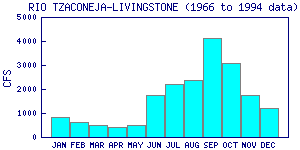
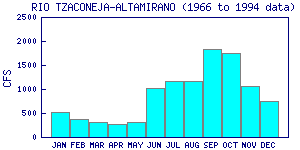
Flow Notes: There is no useful on-line gage. You do need the luck of recent rains to catch the water on the upper section. The only paved access for a quick look at the flow is the upper TO bridge; the lower will have several more times the flow. My impressions of the upper are with 300 cfs at the TO in September. My impressions of the lower are with 2000 cfs in November. I would say that flows over 600 cfs in the upper, or over 4000 cfs in the lower, would invite more trouble than most kayakers could manage. Here I show historical data from INEGI, both at the road bridge, and at an unknown point further down.
![]() |
|
Shuttle Notes: The only paved access is to the upper TO bridge, close to Altamirano town on the way south to Comitán. The easiest TO there is at the balneario just downstream on river-left. The turn-off for the upper PI is south of the bridge at km 38.2. Take this soon-to-paved road 8.8 km (with good views of the creek) up to the Naranjal turn-in and drive 500m to some houses near the river.
The shuttle routes for the lower sections are almost as long and tough as the kayaking. To Pimienta and Bambú take the rough road east (4wd/high-clearance required) from Altamirano's main plaza. The right turn to Pimienta is found after 3.9 km, take it and follow the road 5.8 km down to the river. The better TO's are along the road upstream of the bridge. The Bambú access is a lot further, about 45 km/3 hours past the Pimienta turn all the way to the end of the road. Stay right at the intersections along the way.
The San Juan access is on a completely different (but also rough) road past the upper Jataté PI and before the lower Jataté (making the lower section shuttle very long and giving another reason to avoid it). From Ocosingo ask the way out to the Toniná ruins, but at km 3.4 take the right fork instead of the left fork to Toniná. 5.9 km later take the left fork at the big curve. From here keep following the main road which eventually turns to gravel. All told it's about 60 km/3+ hours from Ocosingo to San Juan (aka Romulo Calzada). (Fyi it's 12 km further to the Jataté bridge before La Sultana.)
For those without a car, know that there are few buses to these points. I recommend hiring a pickup taxi in Altamirano for the upper sections.
Accommodations: Altamirano has several budget hotels. Ocosingo is the second-closest option.
Nearby Tourist Attractions: not much in this area. The mix of Mayan cultures (Tojolab'al near the upper section, Tzeltal on the road to the bottom section) is interesting.