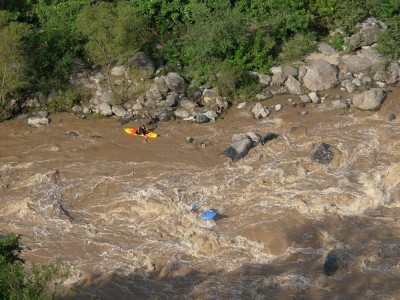
Class: IV+; Ave. Gradient: 8 m/km; Portages: 0-3; Length: up to 53 km; Time: up to 8:00
Season: June to November; rafts? a challenge; Highlights: big waves; Crux move: Lu-Lu rapid
Water Quality: poor; Water Temperature: medium
PI: San Gaspar Ixchil or San Miguel or Cuilco (elev: 1395m/1253m/1145m); TO: roadside down to Canibal
Description: (click here for general notes about my descriptions)
The Río Cuilco is tucked away in a remote section of western Guatemala. It drains the north (drier) side of Central America's highest peak, Tajamulco Volcano. It was practically unknown until recently, but contains the tallest stretch of runnable whitewater in MayanWhiteWater-land, and also the longest one if you include the 75km downstream section, flatter and mostly unexplored, across the Mexican border. In Guatemala, the lower section is the easiest to access and of course has the most water. The valley is impressively deep here (Himalayan scale I would say) and you pass by some high cliffs in parts. There is interesting local culture also, evidenced by the striking dress of the women you will see doing their chores near the river.
The lower sections are ready for a new first descent, having been altered dramatically in 2005 by Hurricane Stan and other floods in recent years. The entire lower Cuilco can be run in a day though most boaters will prefer to bite off a smaller piece. The hardest rapid on the run, "Lu-Lu", is smack dab in the middle. The 2 main points of access are at the start in San Gaspar Ixchil and the Cuilco I bridge, 35 km downstream. In between these points there are many other access points (at least 4 above Lu-Lu), and below Cuilco the river is roadside. The last point of access is at the Canibal bridge.
From San Gaspar Ixchil the river is quite flat with II+ rapids for an hour. Then some bigger bouncier rapids appear, class III to IV depending on flow. You will pass many hammock bridges in this part with a couple having car access. Perhaps the most interesting access point is at San Miguel, at 20 km (1:30 to 2:30) into the run. You will recognize its large church looming over the river-right bank near the hammock bridge.
It is 15km and around 3 hours from San Miguel to Cuilco. The first half continues similar to above, III- to IV- depending on flow. Near the end of this warm-up section is the Chejoj hammock bridge with car access. 3 km below you encounter the river's biggest rapid, Lu-Lu, where you have to negotiate multiple drops over and around big pourovers. Shortly below is another big and technical IV+ rapid (perhaps class V at big water). The rest of the run down to Cuilco contains many more class III to IV+ rapids. All the rapids can be portaged along the bank.
Canibal is 18km downstream of Cuilco, 2 to 3 hours away. The run is all road-side here giving many TO options. The best rapids happen early on. On a low-water run I encountered mostly class II, with a few III/IV-. On a high water run it was much more in the III to IV+ range, with many fun rapids that throw you around, and some great surf waves below the San Juan hammock bridge about 8km down.
Rafters looking for advanced-level rapids will find it here in higher water. I don't guarantee there won't be a portage or two, though.
Expect brown water.
Flash Flood Danger: normal. no gorges.
Descent History: First descent of the lower-lower (from Cuilco II) was on 05.11.03 by Greg Schwendinger. First descent of middle-lower (from San Miguel) was by Roberto Rodas, Gary Chrisman, and Greg Schwendinger on 10.10.04 (it was attempted by rafters years earlier but they bailed at Lu-Lu and hiked back up). First descent of the upper-lower (from San Gaspar Ixchil) was on 01.09.10 by Greg Schwendinger.
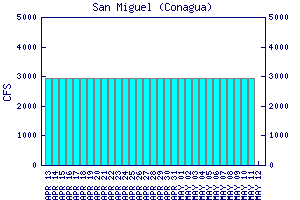
Flow Notes: The most useful gage is way downstream at San Miguel, Mexico (below the confluence with the Río Independencia), linked to below. In 2010, 17,000 cfs on this gage gave about 4,000 cfs at San Gaspar Ixchil (the highest I've seen it). During the rainy season you can be sure of a boatable flow in the lower bits, but in low-water years it may be bony at San Gaspar Ixchil. If the Selegua (alongside the border-to-Huehuetenango road) has runnable water, the Cuilco probably does also. The Cuilco is a bigger river than the Selegua, but also wider/shallower, and its season is a bit shorter. Here are I also show historical flows at a point well downstream of the Mexican border.
![]() |
![]() |
![]() |
|
Shuttle Notes: The lower Cuilco area is accessed off the Huehuetenango-to-border road (Interamericana highway), turning off on the Colotenango road at km 287.8. From Colotenango the main road goes over the ridge to the Cuilco valley, staying high through Ixtahuacán, eventually dropping down to Cuilco and then follows the river to Canibal.
The turn to San Gaspar Ixchil is 500 m out of Colotenango just over the ridge: take the left fork and follow the paved road down 2.9km to the bridge.
The turn to San Miguel is at km 303.3 past Ixtahuacán. Turn left up a steep dirt road and follow it 6.8 km to San Miguel. The closest bridge, described above, is just past the church. A 4wd/high-clearance car is recommended. (note there are 2 other bridges nearby you can driver to: the "La Hamaca" bridge upstream through town, and the "Agua Caliente" bridge downstream.)
The turn to Chejoj is about a half hour past Ixtahuacán before a place called Islan, then it's 3 km more down to the river. To get to Cuilco, stay on the main road about a half hour further (1 1/2 hours total from Colotenango). You will cross the Cuilco I bridge on your way into town.
The roads in this area are subject to seasonal degradation so ask about road conditions. There are regular buses to San Gaspar Ixchil and Cuilco but not to San Miguel or Canibal.
Accommodations: You can find basic hotels in Colotenango, Ixtahuacán and Cuilco.
Nearby Tourist Attractions: the roads are scenic, and you can also search out the primitive hot springs in the area.